Home / Services / Custom equipment and poka-yoke fixtures
Poka-yoke fixtures, test stands and custom production equipment
Purpose-built equipment for one part and one process: assembly and verification stations that make a missed step impossible, leak and functional test stands, presses and crimping machines, adhesive dispensing cells, gages and inspection fixtures — designed, built, installed and run off on your floor.
Most defects that reach a customer were possible long before they happened. A part could be loaded backwards, a clip could be skipped, a press could run the wrong program, a bender could drift out of calibration and nothing downstream would catch it. Purpose-built equipment removes the possibility rather than adding another inspection step.
ENQUIPA designs and builds that equipment for manufacturers in Spartanburg, Greenville, Greer, Duncan and across the Upstate of South Carolina, and travels on-site nationwide. One engineer owns the project from the scoping call through installation and run-off.
Poka-yoke assembly and verification stations
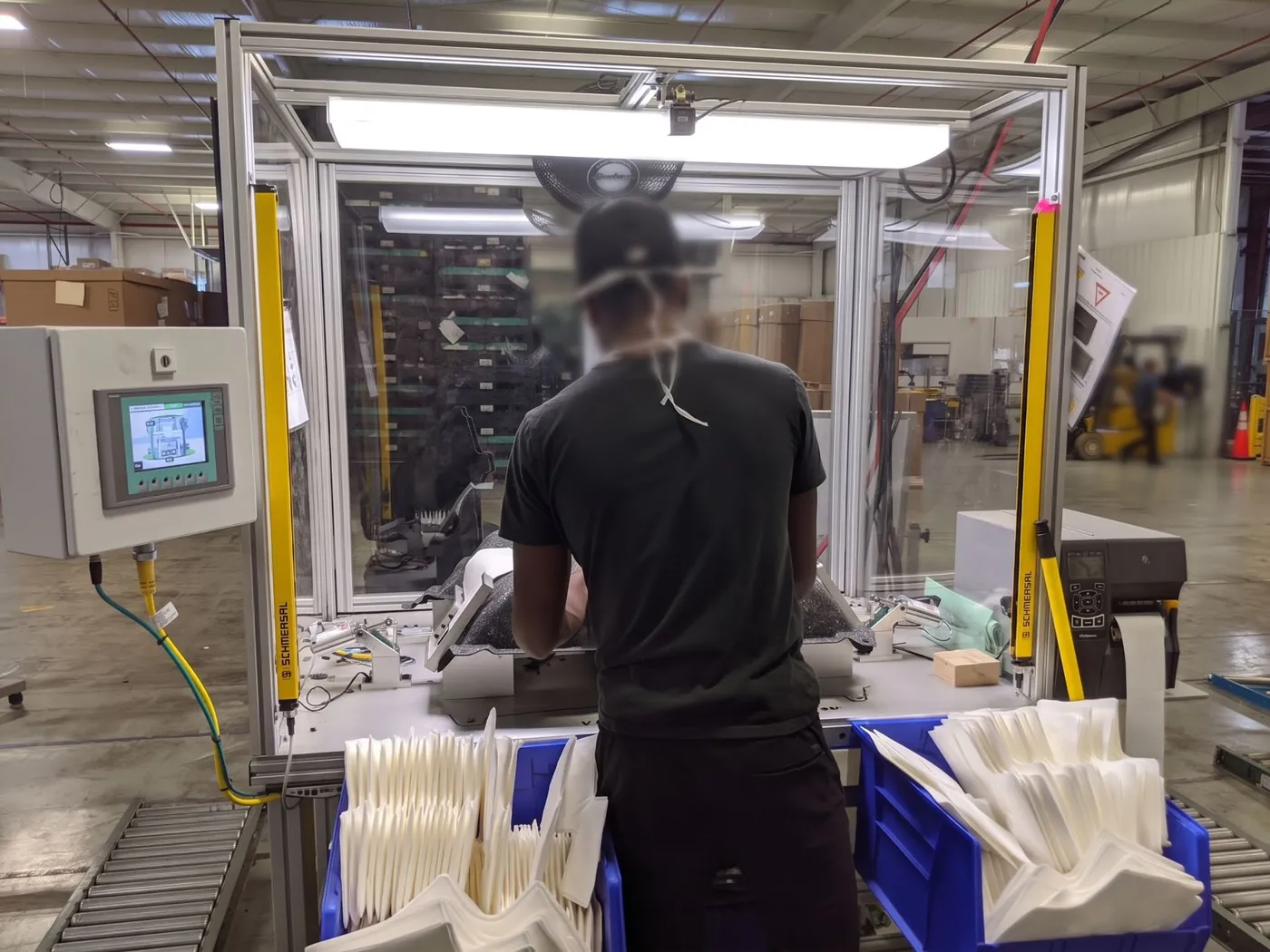
A verification station positions the part in an alignment fixture, locks it for the duration of the build, and checks each component as it is installed. Vision sensors confirm presence and position, an HMI shows live step status, and the fixture will not release the part until every check returns a pass. Labels can be printed at the station so an unverified assembly never gets one.
These stations are built on mobile aluminium frames with light-curtain guarding and task lighting, so they can be moved between lines as the product mix changes. A recent station for a Tier-1 automotive interior supplier in Duncan has run since implementation with no skipped steps and no missing components.
Leak, pressure and functional test stands
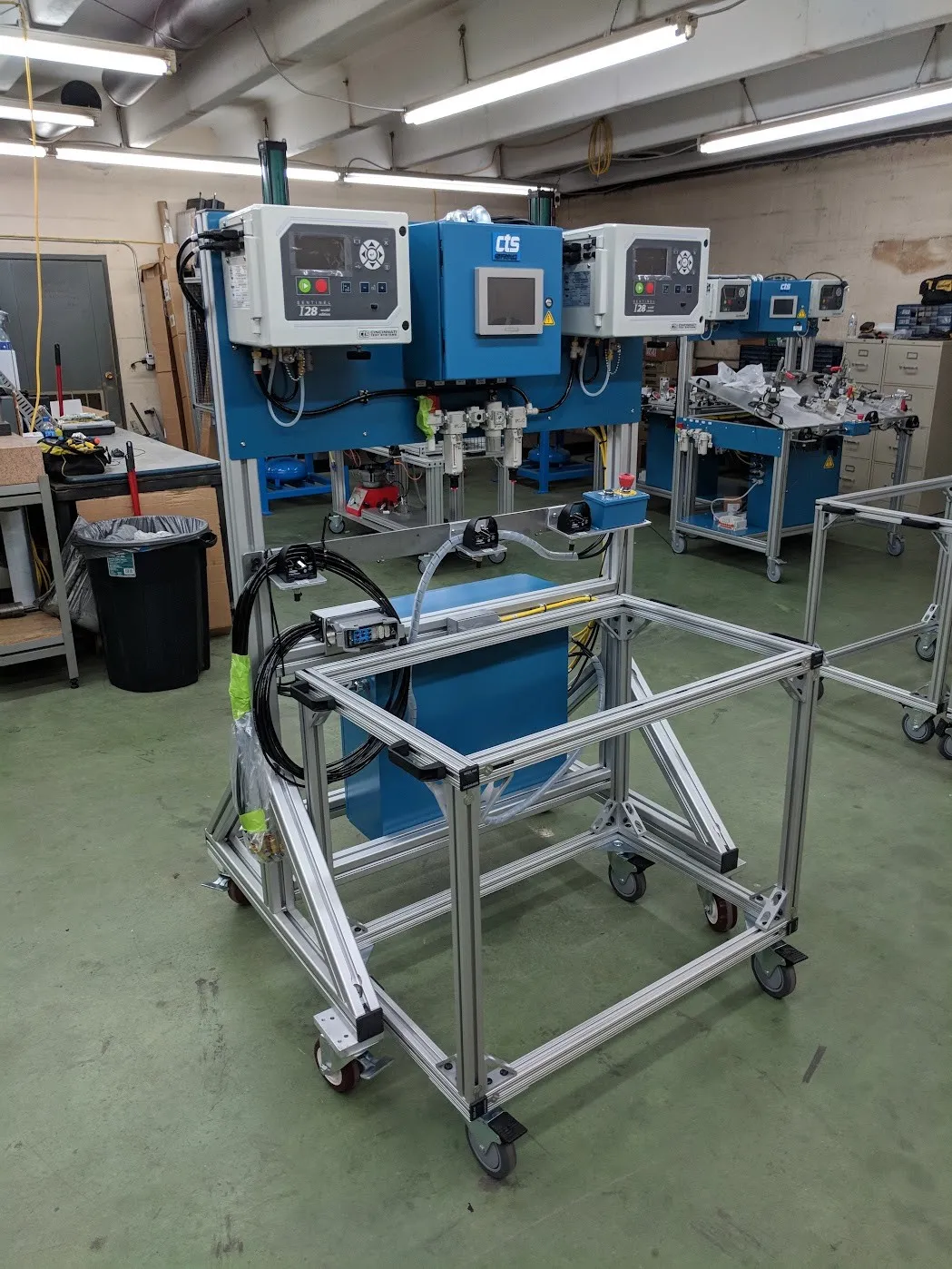
Pressure-decay leak testing to an OEM specification, built around Cincinnati Test Systems instruments with custom fixturing, sensing, PLC control and an HMI. Twin-station layouts let an operator load and unload one part while the other is under test, and barcode scanning selects the correct test program so the wrong part cannot run the wrong recipe.
Changeover is part of the design, not an afterthought. On a second generation of tooling for the same customer, each fixture moved onto its own rolling cart because the interchangeable plates were heavy to lift — which removed manual lifting from changeover entirely.
Presses, crimping and swaging machines
Hydraulic and pneumatic presses with purpose-designed orientation fixtures that position the part and the fitting before the cycle starts, full perimeter guarding, light curtains and emergency stop to current safety standards. Where the iron is still serviceable, a rebuild is usually faster and cheaper than a new machine: stripped to bare metal, powder coated, then rebuilt with new components, a new control system and an HMI.
Go/no-go gages and inspection fixtures
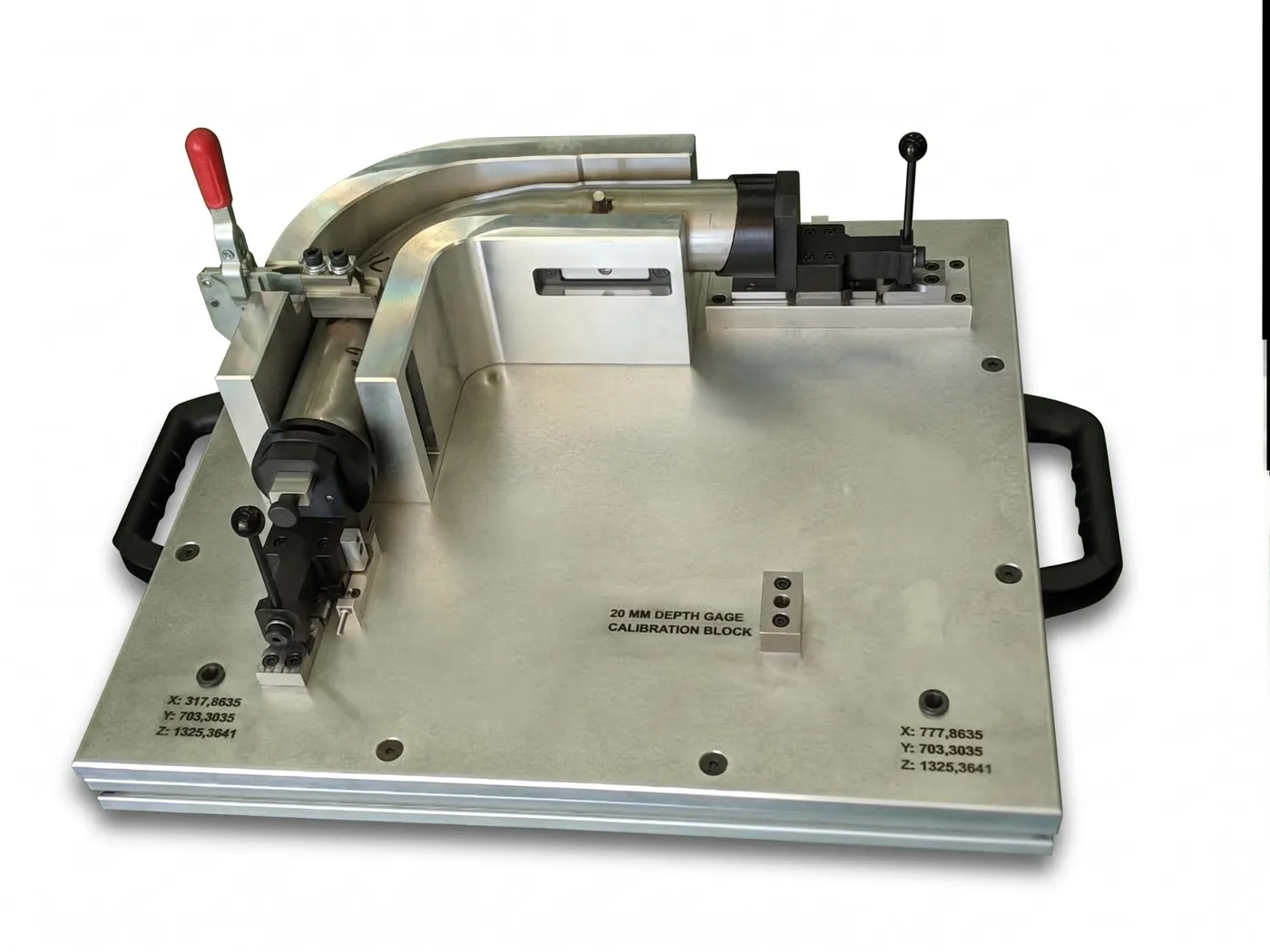
Gages that answer one question on the floor, in seconds, without a CMM appointment. Drop the part in, clamp, check the profile and depth against hard datums — no measurement to interpret. Datum coordinates can be engraved into the plate and an onboard calibration block lets the gage be verified at the station instead of being sent out.
Adhesive dispensing and bonding cells
Metered adhesive dispensing with a Loctite Bond-A-Matic system, two-hand safety start, indexing to a specified orientation and compression held through the full cure window. A barcode scan at startup loads the correct recipe, so the wrong part cannot run the wrong program.
What you get
- Concept and mechanical design in SolidWorks, dimensioned to GD&T and checked for tolerance stack-up
- Fixture and tooling design, pneumatics, sensor and instrument integration
- Safety guarding, light curtains and emergency stop to current standards
- Control enclosure, PLC and HMI, delivered with our controls engineers and programmers
- Build, installation, run-off and operator training on your floor
- Released drawing package and technical documentation you keep
Typical lead times
From real projects, not estimates: 2 to 4 weeks for an inspection gage, 6 to 10 weeks for a leak test stand, 10 to 12 weeks for a poka-yoke verification station, and 10 to 16 weeks for a complete machine rebuild. Your range is confirmed in a fixed-price quote after the scoping call. No hourly billing.
Questions we get
- What is a poka-yoke fixture?
- Tooling that makes a mistake physically impossible, or impossible to pass on. The part loads one way only, sensors confirm each component, and the fixture holds the part until every check passes.
- Do you handle controls and PLC programming?
- Yes. Mechanical, fixture, pneumatic and safety design are in-house; electrical design, PLC and HMI programming come from controls engineers working under ENQUIPA direction.
- Can you rebuild a machine instead of replacing it?
- Often. If the frame and the process are sound, a rebuild brings an obsolete machine back to current standards for a fraction of new-machine cost and lead time.
- What do you need to quote?
- The part or an old drawing, a photo of the current process, the cycle you need, and the defect you are trying to stop.
Built for this service
CUSTOMER NAMES WITHHELD